
Guaranteed paid internships
Hospitality management internships: half of hotel school is a payslip
Six months on campus, six months on a hotel payroll — three times over. You leave with a degree, 18 months of industry experience and CHF 43'000+ gross already earned.
The model
Study, work, repeat
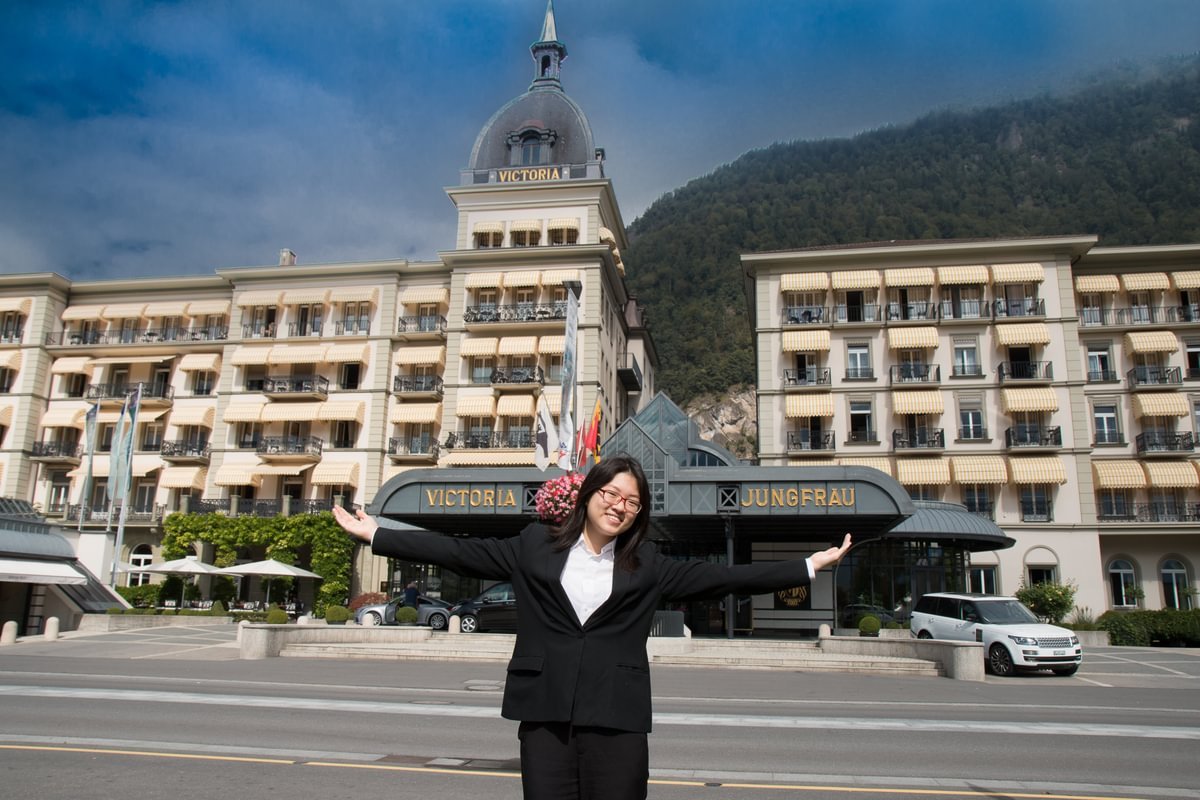
The Swiss hotel school format alternates half-years. You spend six months on campus in Lucerne, then six months in a hotel or hospitality business — in Switzerland or abroad — in a real, paid position. Then you come back, and do it again.
Across the three-year bachelor that is three placements, eighteen months. By the time you graduate, your CV shows more operational hotel experience than most graduates accumulate in their first two years of work.
BHMS describes these placements as guaranteed. It does not publish a placement-rate percentage, so this site does not quote one.
The arithmetic
What eighteen months is worth
The gross figure BHMS publishes for internships in Switzerland is CHF 2'390 a month. Multiply it out.
| Placement | When | Length | Gross at Swiss rates |
|---|---|---|---|
| Internship 1 | After Year 1 · Semester 2 | 6 months | CHF 14'340 |
| Internship 2 | After Year 2 · Semester 4 | 6 months | CHF 14'340 |
| Internship 3 | After Year 3 · Semester 6 | 6 months | CHF 14'340 |
| Total | Across the bachelor | 18 months | CHF 43'020 gross |
CHF 2'390/month is the figure BHMS publishes for placements in Switzerland, before deductions for room, board, tax and social insurance. Placements outside Switzerland are paid at local market rates, which differ.
The honest version
Gross is not what lands in your account
Most schools quote the gross figure and stop. Here is what BHMS itself says you actually keep.
~CHF 1'500
per month, if your placement is outside the cities and your employer provides accommodation and meals
CHF 800–1,000
per month, if you take a big-city placement and pay for your own accommodation
Both figures are quoted directly from the BHMS FAQ, after deductions for taxes, meals and insurance. The difference between them is mostly accommodation — which is why a countryside placement with staff housing often leaves you better off than a city one that sounds more glamorous.
Where you go
Swiss houses and international flags
BHMS displays more than 40 employer logos on its internships page — among them Accor, Four Seasons, Hilton, Kempinski and Mandarin Oriental. BHMS does not publish a complete named partner list or an exact partner count, so this page does not invent one.
Placement inside Switzerland depends very much on your German, French or Italian — BHMS says so directly. That is one reason German communication is a Year 1 module. Placements outside Switzerland are also available, and are paid at local market rates.
Careers & employers“BHMS has been our trusted recruitment partner for over two decades.”
Maya Schroeder · Frenchman's Creek Beach & Country Club, Florida
Practicalities
Three things to know before you plan your budget
No outside work on a student visa
BHMS states that students requiring a visa to study in Switzerland may not work outside the internships included in their programme. The internships themselves are part of the programme, so they are permitted — but you cannot add a side job on top.
Language shapes your options
Teaching is in English, and you do not need German to enrol. But Swiss placements depend heavily on German, French or Italian, so the language modules are worth taking seriously from week one.
Earnings offset, not replace, fees
Internship income reduces the real cost of the degree — it does not cover it. Plan your funding on the fee figures, and treat the CHF 43'000+ gross as the offset it is.
See the full year-by-year cost against expected earnings on the fees page. What the experience leads to after graduation, with official pay data: our hotel manager salary guide.
Questions
Straight answers
What is a hospitality management internship at BHMS?
A six-month paid position in a hotel or hospitality business, built into the programme. On the BHMS bachelor every academic semester is followed by one, three in total, in Switzerland or worldwide. BHMS publishes CHF 2'390 per month gross for internships in Switzerland.
How many internships are there, and how long is each one?
Three, six months each. Every academic semester of the three-year bachelor is followed by a six-month internship placement — 18 months of paid industry experience by graduation. The Postgraduate Diploma includes one six-month placement. On the MSc the internship is optional, and the Graduate Certificate has none.
How much do interns earn?
BHMS publishes CHF 2'390 per month gross for internships in Switzerland. That is before deductions for room, board, tax and social insurance. Across the three bachelor internships the gross total comes to more than CHF 43'000.
What is left after deductions?
BHMS answers this plainly in its own FAQ: if your internship is in the countryside and your employer provides accommodation and meals, you might have around CHF 1'500 left after deductions for taxes, meals and insurance. If you prefer to live in a big city without accommodation provided, you typically have around CHF 800 to 1,000 remaining.
Where do placements happen?
In Switzerland and worldwide. BHMS displays more than 40 employer logos on its internships page, among them Accor, Four Seasons, Hilton, Kempinski and Mandarin Oriental. BHMS does not publish a complete named partner list or an exact partner count, so no total is claimed here.
Do I need German for a Swiss placement?
It matters. BHMS states that placements inside Switzerland depend very much on your German, French or Italian language skills. German communication is a module in Year 1 for exactly this reason, and placements outside Switzerland are also available.
Can I take a part-time job alongside my studies?
No, if you need a visa. BHMS states that students requiring a visa to study in Switzerland are not permitted to work outside the internships included in their study programme. The internships themselves are part of the programme, so they are permitted.
Watch
See it for yourself
Next step
Three intakes a year. A degree that pays you back before you graduate.
Next intakes: 16 November 2026 · 22 February 2027 · 16 August 2027 · Lucerne, Switzerland
Every academic semester is followed by a six-month paid internship — CHF 2'390/month gross in Switzerland, three times across the bachelor. How the internship model works →